

My Interview with Iefimerida - 36-year-old Vanessa left Germany and moved to Chania with her son - She describes her life there and what drew her to Crete

Vanessa Badura left behind a stable but suffocatingly structured life in Germany and two years ago moved to Crete with her son.
She was looking for more freedom, authenticity and a different way of life. Today, Chania is her home. Speaking with her, she explained to me how this decision changed not only her daily life, but also the way she sees herself and the world.
The moment when everything changed
Her life in Germany, where she comes from, was organized, fast-paced, and professionally successful. As a photographer , she had built a career that, on the outside, seemed ideal. But, as she describes, she had a constant feeling that something was missing.
The big change in her life came after the end of her seven-year marriage. She was married to her ex-husband for 7 years, while their relationship lasted 14 in total. During that time, as a single mother, she began to redefine everything: her life, her choices, even her own success.
"I started to wonder how I really wanted to live and what example I wanted to set for my son. It wasn't a spur-of-the-moment decision. It was the result of a long internal process. I no longer wanted to live just for stability and routine. I wanted to feel alive and find myself again," she emphasizes.
Crete as a new beginning - Why did he choose it?
Greece was no stranger to her, as she had spent summers in the Peloponnese as a child, and had visited Zakynthos, Athens, Thessaloniki, Larissa, and other areas. However, Crete won her over from the very first moment.
Her first contact with the island, and especially with Chania, proved decisive. She describes an almost inexplicable sense of familiarity: sea, mountains, people and light composed an environment that immediately felt “right”.
“From the first time I came to Chania, I felt something that I still can’t fully explain. There was an immediate sense of warmth, openness, and inner peace. The people, the sea, the mountains, the sunsets, everything gave me a deep sense of grounding. Chania gave me the feeling that life can be simpler, more authentic, and more connected.”
Crete, she believes, combines two seemingly opposite worlds: the tranquility and intensity of nature. On the one hand, the beaches and the sense of freedom, on the other, the villages, traditions and a deeply rooted identity, as well as a sense of community that is difficult to find elsewhere.
"I felt like it gave me the space to rebuild myself and create a healthier and more mindful life for myself and my son," she explains.
Her favorite places?
She can't get enough of Chania and southern Crete. "The old town, the sea and the mountains are something unique to me. I like discovering hidden beaches and traditional villages. I'm a big fan of Balos, but I prefer the less touristy places, as well as our own little "secret" spots," she answers.


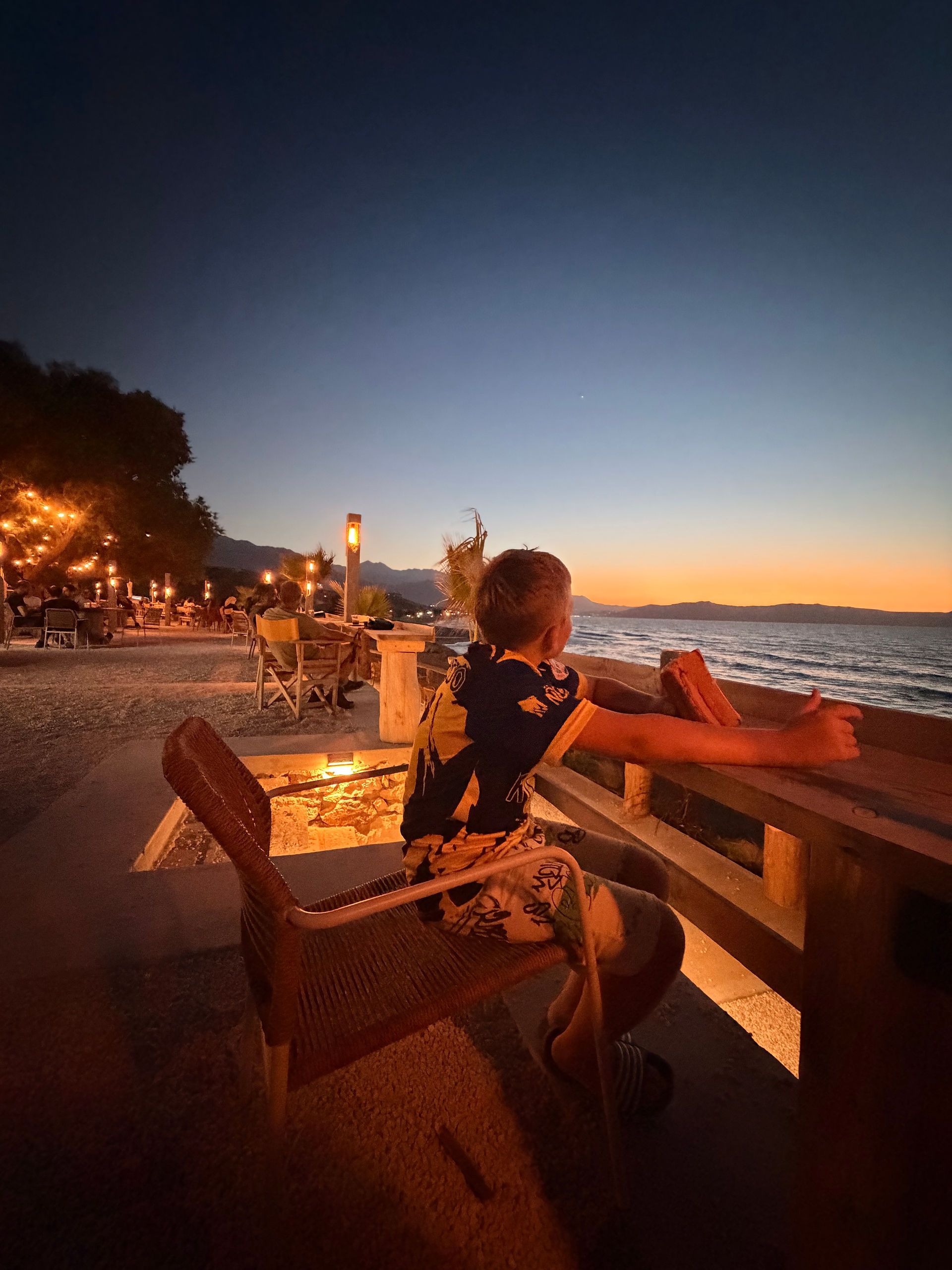


Motherhood, change and difficult decisions
Relocating with a seven-year-old child was not a simple matter, especially since the child's father initially did not agree.
There were difficult months during which third parties put pressure on the couple. As a result, she herself as a mother constantly questioned herself, but she felt that this was the life she wanted for her son. “I wanted to set an example for him that one can create one’s life with courage,” she says characteristically. And today she says confidently: “It was one of the best decisions of our lives.”
Her family's reactions in Germany were mixed. However, many changed their minds when they visited Crete and saw the life they have built.
A multicultural family
Vanessa lives in Chania with her 9-year-old son and her partner, who is originally from the United Kingdom. In their home, they speak many languages and combine different cultures, which the 36-year-old considers a significant advantage for the child.
She uses three languages in her daily life and would have liked to have grown up in a similar environment. “Crete facilitates this dynamic, because it is open, and at the same time deeply connected to its tradition,” she points out.
Raising a child in Crete
Her son attends a bilingual school in Chania and adapted extremely quickly, which she attributes to the fact that children are very resilient and adapt much faster when they feel safe and loved. Comparing raising a child in Crete with Germany, she emphasizes that here children live more outside the home, have contact with nature, with different generations, and grow up more freely and socially, without stress.
Of course, she herself observes: "Of course, every country has its positives and negatives. In terms of organization, Germany is more structured. But emotionally and socially, Crete offers a very beautiful environment.
Everyday life, work and adaptation
Vanessa works as a photographer , content creator, and business mentor/holistic coach, helping people build or expand their businesses internationally. Her work is mostly done remotely, which has made her current lifestyle possible.
Her Greek is already at a very good level (she understands about 90%) and she makes sure to learn constantly. When she speaks Greek, many Cretans do not believe that she is German because of her very good accent. She says that even a simple attempt at communication opens many doors and creates immediate bonds with people.
She now considers Crete her home and cannot imagine herself living anywhere else right now. However, her adjustment was not always easy. The biggest difficulties she faced were the bureaucracy (especially when starting a business) and adapting to different rhythms. “In Germany, everything is structured and predictable. Here I learned what it means to be patient, flexible and to let go of control,” she admits.
At the same time, she was won over by human contact, a sense of community, and a slower, more conscious everyday life.
"The locals welcomed me from the beginning with a lot of warmth and kindness. Cretans are known for their hospitality and I experienced it personally. Integration is a process that takes time. I deeply respect the culture and try to contribute positively to the community. Emotionally, I now feel very attached to Crete, although I will always carry a piece of Germany within me," she emphasizes.
As for what the biggest difference is in her daily life? The sense of freedom and experiencing the moment. "In Germany everything was more rushed and productivity-oriented. In Chania I spend more time outside, with people, and I appreciate the little moments much more," she emphasizes.
The life that was rebuilt
Beyond everyday life, she describes Crete as a place of inner renewal. Chania, the nature, the people and the rhythms of life contributed to a profound personal change.
She doesn't single out a single moment as the most important, but rather a set of experiences: watching her son build a new life in Crete, the sunsets after difficult times, the new people she met, and daring to radically change her life.
Thoughts, advice and the future
To those thinking about taking the same step, he suggests listening to themselves and not fear. Relocation, he says, is not always easy, but it can lead to profound personal development.
Specifically, she advises women living in other countries who are considering immigrating to Crete: "Don't idealize everything - there will be difficult days. But if you are open and willing to adapt, Crete can offer you freedom, healing and evolution."
As for whether she is thinking of staying permanently in Crete , her answer is clear: "For now, Crete is truly my home. I have built a life, relationships and connection in Crete. Life can always change, but right now I see my future here. Having my little family in Crete means everything to me. We are renovating our house in a village and I can't imagine myself anywhere else."
For Vanessa, the biggest lesson Crete taught her is that life is not just about survival and rushing. “It’s important to slow down, trust life, appreciate nature and simple moments. And most importantly: Sometimes the bravest choice is to follow a completely different path than what others expected of you,” she concludes.


